The shapes, woods, colors and lighting that define mid-century modern, how to mix it with what you own, buying vintage, and the mistakes that make it a theme.
- ✓ Mid-century modern means tapered legs, warm woods like walnut and teak, organic curves and clean, low lines.
- ✓ One or two statement pieces mixed with simple contemporary basics look better than a full period set.
- ✓ Balance the warm wood with light walls, texture and a few bold accent colors.
Mid-century modern has outlasted almost every trend since it began, because it was designed to be lived with: comfortable, practical and good-looking from every angle. The challenge today isn’t finding mid-century pieces; it’s using them so your home feels current rather than like a film set.
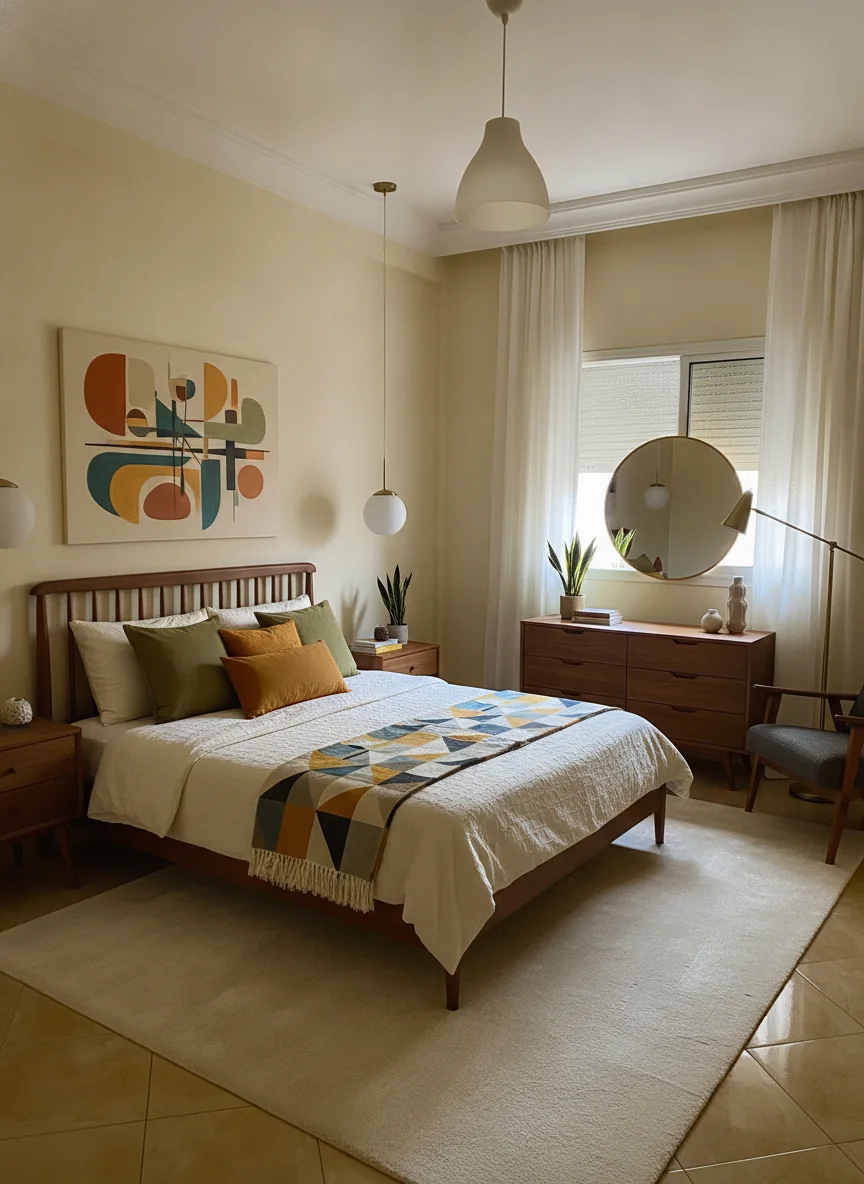 An empty bedroom redesigned with Tigmi’s Mid-Century Modern style: a walnut bed with a slatted headboard, a geometric throw and print, a round mirror and an arc floor lamp.
What defines the style
Mid-century modern covers design from roughly the mid-1940s to the late 1960s. You’ll recognize it by:
- Tapered, splayed legs that lift furniture off the floor.
- Warm woods: walnut, teak and rosewood, often as veneer.
- Organic curves next to clean lines: a kidney-shaped table, a shell chair, a long low sideboard.
- New materials of the time: molded plywood, fiberglass, bent metal.
- Low profiles and furniture meant to be seen from all sides.
- Graphic textiles and art: geometric prints, abstract canvases.
Some designs became icons and are still made under license today, such as the Eames Lounge Chair (1956), Eero Saarinen’s Tulip table and George Nelson’s Bubble lamps.
The palette
Start with warm wood as the main color, then keep walls light (warm white, soft cream) so the wood stands out. Add one or two accents from the period palette: mustard, burnt orange, olive, teal or deep blue. Black appears in thin lines, like chair frames and lamp stems.
How to mix it with what you own
The best mid-century rooms today are 70% simple and 30% period.
- Pick one statement piece per room: a sideboard, a lounge chair or a dining set.
- Keep the rest quiet: a plain sofa with slim arms, a simple rug, white or light walls.
- Repeat the wood tone two or three times (a frame, a side table, a shelf) so the statement piece doesn’t look stranded.
- Add texture: wool, bouclé or leather keep the room from looking flat.
Lighting
Mid-century lighting is part of the look: globe pendants, Sputnik-style chandeliers, arc floor lamps and mushroom table lamps. Use warm 2700K bulbs and at least three light sources in a living room, at different heights.
Buying vintage, smartly
- Check the structure: wobbly joints and lifting veneer are expensive to fix. Solid frames with surface scratches are easy to refinish.
- Measure height and depth, not just width. Period sofas are often shallower than today’s.
- Mix sources: one vintage piece, the rest new. A full room of vintage pieces is costly and can feel like a museum.
- For famous designs, buy licensed versions or vintage originals rather than unlicensed copies, which are often poorer quality.
Mistakes to avoid
- The full period set. Matching sideboard, coffee table and chairs from the same era reads as a theme.
- Too much dark wood. Balance walnut and teak with light walls, light rugs and some white or pale fabric.
- Too many accent colors. Mustard, teal and orange together is a lot. Pick two.
- Sacrificing comfort. Some period chairs are lovely and hard. Sit before you buy.
Try it on your room first
Mid-century furniture is all about proportion: how a sideboard sits under a window, whether a lounge chair fits a corner. With Tigmi you upload a photo of your room and choose the Mid-Century Modern style; in a couple of minutes you see your own room, same walls and windows, redesigned in it. Add notes like “keep my sofa” or “walnut sideboard under the window”.
Then Shop the Look (on paid plans) finds pieces similar to the ones in the image from real stores in 45 countries, so you can compare new pieces against vintage finds. Your first redesign each month is free.
Related: modern style in our glossary, and our Japandi guide for a calmer take on warm woods.
Tigmi Team
Product & EditorialThe people who build Tigmi, an AI tool that redesigns real rooms from a single photo. We write about what we learn testing styles, prompts and room photos every day.
Frequently Asked Questions
What years is mid-century modern?
Roughly the mid-1940s to the late 1960s. It grew out of modernism and the Bauhaus, softened by new materials like molded plywood and fiberglass and by Scandinavian craft.
What colors go with mid-century modern?
Warm wood tones as the base, light walls, and accents of mustard, burnt orange, olive, teal or deep blue. Use two accents at most in one room.
Can I mix mid-century with other styles?
Yes, and it usually looks better that way. It pairs well with Scandinavian, Japandi and contemporary furniture. Keep the lines simple and let the mid-century pieces be the stars.
Ready to see your room reimagined?
Upload a photo of your room and get a photorealistic redesign in a couple of minutes. Your first redesign each month is free.